I wrote a short story (a feat for me in itself). It got shortlisted for The Furphy Literary Award, which means it will be published in The Furphy Anthology Book 2025 at the end of this year.
But you can read it now, if you choose to 👇
Congratulations to the winner, Serena Moss, who wrote a corker of a tale, The Eulogy Business.
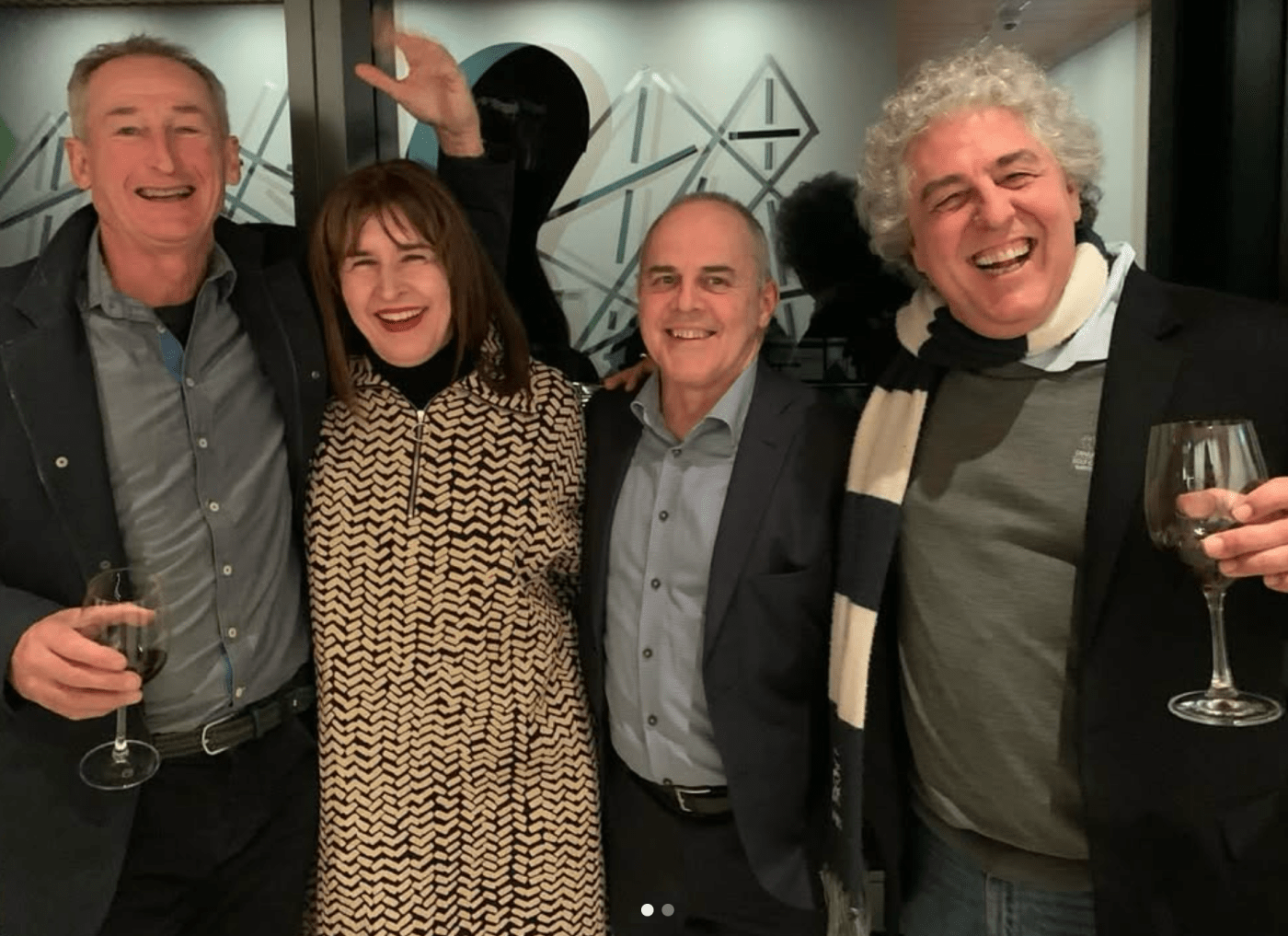
Photo (l-r): Anson Cameron (Writer and Furphy Judge), me, Damian ‘Dips’ O’Donnell (Accountant and Shortlisted Author), John Harms (El Presidente of El Footy Almanac and Furphy Judge)
The Undying Love of Specimen A398
By Emma Westwood
Barry is a corpse. In a previous life, Barry – aka Baz/Bazza/Sparky/Shit for Brains, etc., etc. – choked on a fried chip at the local pub. Having already necked his final pint for the day – and with Old Mate on the stool beside him nodding off over his own empty glass – there was neither a helping hand nor a finger of warm beer to help him dislodge it. By the time Old Mate had blinked his rheumy eyes open, Barry was lying on the sticky carpet in a pool of piss. Cardiac arrest from the sheer shock of it, apparently.
‘Rest in piece Bazza,’ says the bronze plaque on the back of the barstool. It was the decent thing to do, for the publican to memorialise him, considering he’d spent the majority of his time and pension there. Barry had worked in some capacity in electronics back in the day, or so the rumour mill had turned, but that was all by the by, given he had dedicated his last twenty-two years of mortality to keeping the pub afloat one pint at a time. Despite Barry’s loyalty, no one really knew all that much about him. Hardly a word had passed through his lips, only tap-pulled Carlton Draught and the occasional helping of chips, including the fatal one.
Barry goes by a different name these days: ‘Specimen A398 of plot #4975’. Contrary to the pub plaque, there is no resting in piece – or even ‘peace’ – for Bazza. He bears the heavy weight of posthumous responsibility on his shoulders, in the form of two hundred kilograms of rock and rubble. How he got here, no one really knows either. Maybe he’d signed something then immediately forgot about it? There had been no family members or friends to inform of his death. He was alive and then he was not, littering the morgue with the neglected carcass in which Barry, the sentient being, had well and truly outstayed his welcome.
The morgue visit was short. Following some mandatory red tape, what was left of him took a road trip to a high-security facility at the base of the Blue Mountains where he was delivered in a plastic cylinder rather than a coffin. Young women dressed in white coveralls and industrial-grade goggles, gloves and boots laid out his remains in his permanent plot under towering gumtrees. They laid him out naked, much to Barry’s eternal embarrassment, negotiating his newly acquired state of rigor mortis before anchoring him with a blanket of stone. He is going nowhere now, but in doing so, he has taken on more purpose than he’s ever had across his sixty-nine years of breathing.
The mainly female coterie attends to him regularly. A faithful harem of scientists typing who-knows-what in their digital notebooks. There is one, a young blonde, who speaks to her associates with a thick Scandinavian accent. She removes the rubble from his body for inspection with painstaking precision. She might expose his face, or his legs, or his abdomen, sometimes even his groin. If Barry’s bloodshot eyeballs had not shrivelled into tiny raisins, he’d find her quite lovely to look at, despite the full extent of her loveliness obscured by uncomely glasses, breathing apparatus and headwear.
Her own eyes often widen with delight when she looks at his body, something that Barry is unaccustomed to. She never fails to wear an inquisitive expression, her seriousness betrayed by brow-furrowing and the darting dance of her eyes as they take in every little detail of him. He would blush if he had any circulation or cheeks left. The delicate way she uses instruments to lift the matter on his bones, the precise nature in which she cuts away a sample here and there, her general overprotectiveness of his corpse from the rest of the harem. Never has Barry been the subject of such intense female attention before. It is ironic to have waited until death to be so important, so interesting.
Every day, the crunch of her heavy boots on the gravel pathway announces her imminent arrival. Birds, rodents and snakes notice it, even if Barry doesn’t – because he’s dead. If his nervous system was operational, there would be tingling in his loins at the sounds of her approach. Just the thought of her returning to him would be a massive thrill. She walks with an offbeat rhythm to her gait – a limp of sorts. It’s something that Living Barry would have asked her about, her endearing physical trait, perfect in its imperfection. But even if she had stood beside him at the pub when he was alive – stood there smiling at him, the warmth of a stranger looking for a new friend – he’d have choked on his words, if not that chip.
She opens the wire cage that protects his plot from curious bush creatures. What they have now is something special, something he could never dreamt of having in his lifetime. What they share now is a certain type of professional intimacy that allows her to intently explore him with the unconditional consent of a dead body donated to science. Prone, vulnerable to the elements, subject to the scrutiny of this beautiful woman. Dead Barry can get away with it, because Dead Barry can’t even fart out a thought or raise a pinkie.
Dead Barry hasn’t always been gas-free. While he would have never labelled himself ‘windy’ during his living years, those first few days of death were something else. He turned into a human whoopee cushion with phbbt, brrrr and poot sounds trumpeting from his body as he went about eating himself. A couple of his Florence Nightingales, as professional as they would try to be, broke out in giggles at the absurdity of his sound effects – a veritable brass band of the body. If only he could see them laughing behind the breathing apparatus that protected them and their gag reflexes from the rancid stench of his putrefaction. If he still had hearing, his ears would have heard their explanation of this farting phenomenon to a group of university interns – the migration of bacteria once residing in his intestines, breaking free and consequently digesting his internal organs one by one.
With this process came the symphonic display of his own involuntary making, even more pronounced by the flies and other insects that were laying their eggs around his nose, eyes, mouth, anus and genitalia. More gas. It wasn’t long before his rigid body started moving again but with the wriggling masses of maggots. The beer-bloat of his body transmutes into bacteria-bloat that sees him double in size. And the grosser he gets, the more attentive his nurses are. Yet they do nothing to protect him from these necromantic parasites. They leave Barry for dead. To respond to the physical, living world in whatever way his body and its new inhabitants choose. Because his women like to watch.
As Barry decomposes, the relationship with his blonde sweetheart blossoms. She is the worst of them all, Barry’s limping angel of death. His demise excites her in a way that is unbecoming for a young woman, shocking even. To be so drawn to death and decay like this, in the prime of her life. To spend extra-long working days pecking over his discarded body like a bird of prey – a gentle one, nonetheless, but still one that feeds on him in a metaphorical sense. If Barry had any concept of time anymore, he’d say their relationship was at its strongest between Day Three and Day Fifty following his death. That’s when she couldn’t get enough of Barry – their honeymoon period – and, with the ‘freshness’ of their connection, his decomposing form revealed something new and spectacular to her with every rendezvous.
The cynic in him, that existed at an almost cellular level, would have been ready for these salad days to wilt. Because it’s inevitable, isn’t it? Nothing ever lasts, even the good stuff. Even Barry, who some may have called ‘the walking dead’ when he was supposedly still alive, had not failed to notice the years accelerating as he neared his actual death. But time is nothing to him now. Time is eternal.
As much as Barry would want to be alone with his unexpected paramour, death brings strange bedfellows. The lack of life in his limbs summons generation upon generation of insects that ‘squat’ before sending missives to their followers to join their burgeoning corpse community. Barry finds himself hosting an overabundance of houseflies, blowflies, corpse flies and greenbottles – the scourge of both live sheep and dead people. Then, there are the gastronomically named cheese flies. Far from lending themselves to pairing with wines, these flies are named for their love of the ‘cheesy’ aroma of Barry as his rotting frame increasingly liquifies and goes to ground. And the flies are not alone.
There are beetles – carrion and rove varieties – moths and parasitic wasps that gravitate in equal measures to Barry’s thatch of chest, back and shoulder hair, as well as the few strands that still sprout from his head, ears, nose and genitals. Before too long, Barry is a self-contained ecosystem of insect life that his scientific sweetheart oversees with perfect forensic management. She uses tools to pick at his squatters, and at Barry himself. She bags bits of him. She wonders at the growth of his bacterial population, faster in death than it ever was in life. She marvels at the magic of his posthumous development, how his body turns to red and then to brown, liquifies and falls away, miraculously blending with the flora and the earth itself. Specimen A398 of plot #4975 is quite the sight to behold.
Barry approaches Day Fifty of his post-life decomposition. She still comes to him daily – she is still attentive – but he won’t have much to offer her soon. Their time together is nearing its end. He would shed a tear or two if he could, because their unrequited love is perfect in a Gabriela García Márquez kind of way – not that he’d read a book since school, but she looks like the type who reads many and, therefore, would appreciate the analogy. She will never know that he was more than Barry the Barfly. Despite the cliché, he had quite the collection of etchings, as well as a complete discography of Status Quo.
The portions of his carcass that make contact with the ground grow a heavenly, mossy shroud, almost Tolkien you could say. Their deep greens blend what’s left of Barry the Barfly with the grass and trees, wrapping him in their organic embrace. He’s human mulch. Only the chomping and chewing cheese flies truly appreciate what he has to offer now, the mouth-hook maggots and insects of similar physiology having excused themselves for other opportunities. Soon, Barry will enter the dry stage of his decay, where any remaining hair will disappear leaving nothing but his skeleton of increasingly brittle bare bones. Approximately a year after his death, his decomposition will slow to stagnation, and his daily mutation will decelerate too. Just like his presence at the pub, Barry will become part of the furniture, no longer a novelty to be poked, prodded and tested. Just another resident of The Body Farm.
He’s not sure when she stopped visiting him. If there were any synapses firing in his skull, he’d hasten a guess that she left before he was completely spent as a specimen. But it’s hard to say because notions of time and space are now a thing of the past. He lives in the never-never – every time, every where, every thing – it confuses him to wrap his consciousness around it. Regardless of her visa requirements or what she wants to do with the rest of her life or whether she has another love, Barry would feel, if he could feel, the pain of her abandonment – more pain than he’d ever felt when the life left his living body. With the expanse of nothingness engulfing him, his conclusion is forgone: he’ll just have to haunt the hell out of her instead.
 Emma Westwood
Leave a comment